The mountain
Lord of the FliesThe mountain is the island’s highest and most consequential landmark: a route to a wide view of the boys’ new home, the chosen site of their rescue fire, and the setting where a dead parachutist is mistaken for the beast. Its open summit seems to promise command and clarity, but its rocks, darkness, wind, and shifting shadows repeatedly make what the boys see difficult to understand. The mountain’s significance turns on that contrast: it offers a vantage point over the island while also becoming the place where fear distorts perception.
Summit and Setting
Ralph, Jack Merridew, and Simon reach the top by way of pink rock, defiles, and sharp scree. Near the summit, they pause to push a boulder as large as a small motor car. After they set it swinging, it breaks free, crashes through the forest canopy, and leaves the island briefly still after the noise and disturbance. The route then becomes easier, opening onto a half-cirque filled with blue rock flowers, with butterflies lifting and settling in the air. Beyond it, the boys stand on the mountain’s square top.
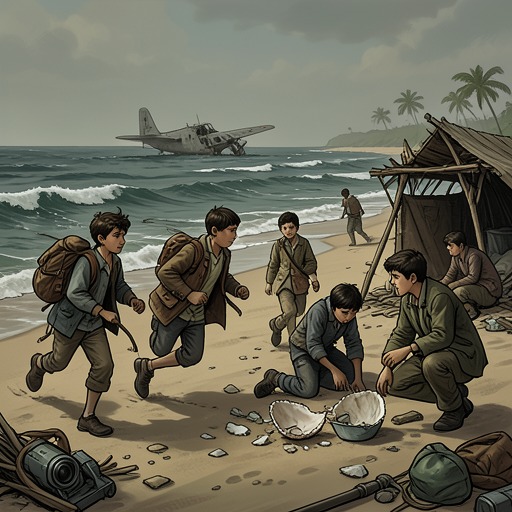
From there, the island’s shape becomes legible. The boys see a circular horizon of water and the island spread below them, with a steep, rocky descent behind and a gentler, tree-covered slope extending toward the dense green flatland. Near one end stands a separate-looking rock, almost detached from the island and resembling a fort. Offshore, a coral reef runs parallel to what they understand as The beach, enclosing peacock-colored water on the inside and meeting the dark blue sea beyond. The view also reveals the scar left by the crash and The platform beside The lagoon, where tiny moving figures mark the boys’ settlement. Ralph traces a quick route back down the slope, through a gully and flowers, toward the scar.
The height gives the boys a brief sense of possession and possibility. Ralph decides that the island appears uninhabited, while Jack Merridew looks toward hunting and finding food until rescue comes. Simon says little, but nods. The boys laugh and shout together on the summit; their shared exhilaration makes the mountain feel like a place from which they can survey and claim their surroundings. That confidence is provisional: the view shows them where they are, but cannot tell them what is moving in the darkness or what the distant figure on the summit will prove to be.
The Rescue Fire and Its Rules
The mountain becomes a practical destination when Ralph argues that the boys must make smoke so a passing ship can find them. The prospect of a fire sweeps the assembly into movement, and the boys follow Jack Merridew toward the summit, leaving Ralph behind with Piggy and the conch. Ralph soon follows. On the mountain’s steeper side, the boys find fallen trees and decaying wood that can be gathered for fuel.
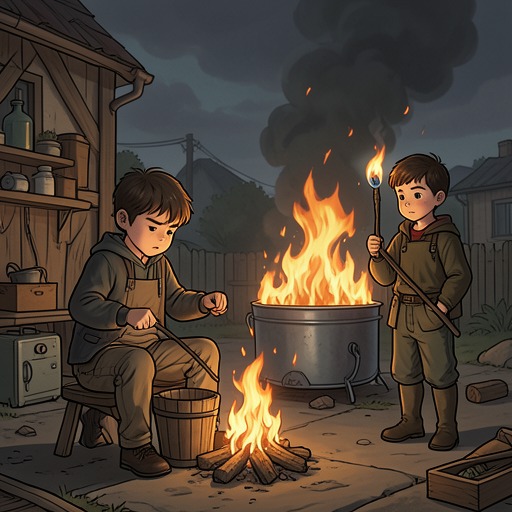
Their first great blaze produces flame rather than a useful signal. The fire rises high, throws sparks, and consumes the pile, but when it collapses the boys see that it has made no smoke. Piggy points out that they have not made a working signal fire; Jack Merridew answers by belittling his contribution, while Simon notes that Piggy helped by lending his spectacles to start it. The disagreement makes the mountain a test not only of practical effort but of who is entitled to speak and whose work counts.
Ralph insists that the rescue effort requires people specifically responsible for tending the fire, and that the rule of the conch should apply at the summit as well as at The platform. Jack Merridew accepts the need for rules and divides the choir, whom he calls his hunters, into groups responsible for maintaining the fire. He proposes that one group take a turn each week, and that green branches be added when a ship is sighted to produce more smoke. The arrangement gives the summit an organized purpose, but the boys also agree that the fire can be allowed to die overnight. Their hopes remain fixed on the horizon even as the first attempt shows how easily the signal they depend on can fail.
The Figure on the Summit
During the night, an explosion in the distant adult world is followed by a figure descending beneath a parachute. Winds carry it across the reef and The lagoon toward the mountain. It falls among the blue flowers, but a breeze catches the parachute and drags the body upward over boulders and red stones until it rests among the shattered rocks at the top. Tangled lines hold its helmeted head between its knees; when the wind pulls taut, the body lifts, then bows forward again as the gusts slacken.
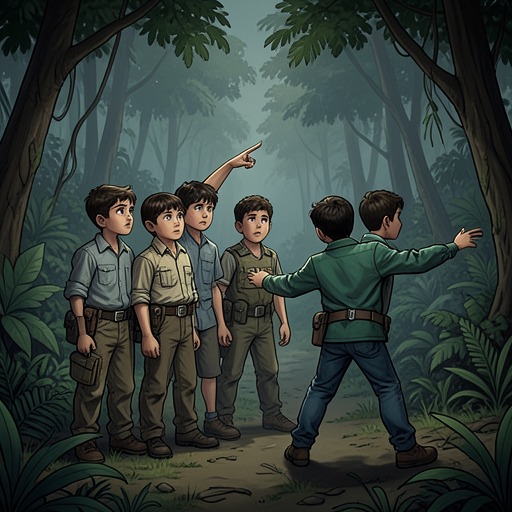
Before dawn, the two boys assigned to the fire approach the darkened remains of the fire and notice that it seems to have gone out. In the darkness, the parachutist’s repeated movement has no clear explanation for them. Later, when Ralph, Jack Merridew, and Roger climb the mountain to look for the beast, the summit is again a scene of uncertainty. Their approach is difficult: wind drives ash into their faces, the dead fire leaves cold, soft ashes beneath Ralph’s hand, and darkness obscures the rocks. Jack Merridew points out a hump where he believes a creature is lying. When the wind moves the figure and reveals its ruined face, the three boys flee, leaving their sticks behind.
The mountain thus makes the boys’ mistaken sighting physically credible without making it true. A body caught in parachute lines moves with the wind; in darkness, at a distance, its shape resembles a living creature. The summit fire’s ashes further complicate the search, limiting visibility and stirring into the air as the boys move. Their fear is shaped by the actual conditions of the place, but those conditions turn a dead man into evidence for the beast they expect to find.
Simon’s Discovery and the Mountain’s Significance
Simon reaches the summit later, weary and struggling against the wind. He sees the humped figure move and initially hides his face, but continues up the mountain. Close to the body, he understands how the tangled lines produce its movement. He examines its bones and decayed features, recognizing the canvas and rubber that hold the remains together. When the wind lifts the figure again, Simon is sickened; then he takes the lines in his hands, frees them from the rocks, and releases the body from the wind’s repeated indignity.
From the summit, Simon looks down toward the settlements. The fire at The platform seems to be out or making no smoke, while a thin line of smoke rises farther along The beach. He sees that most, perhaps all, of the boys are gathered there and infers that they have moved away from the beast. Now understanding that the supposed creature is harmless, though still horrible, he turns to carry the news to the others and starts down the mountain, staggering from exhaustion.
The mountain’s role changes with each ascent. First it offers a view that makes the island seem knowable and theirs; next it becomes the station from which rescue is supposed to be summoned; then darkness and wind turn its summit into the apparent lair of a beast. Simon’s discovery resolves the physical mystery—the figure is a parachutist, not a creature—but the boys’ earlier terror has already shaped their movements and their understanding of the island. The summit exposes both the gap between what can be seen and what can be known, and the consequences of mistaking one for the other.